Understanding the Event Loop-The Heartbeat of JavaScript
11/11/2025 4 min
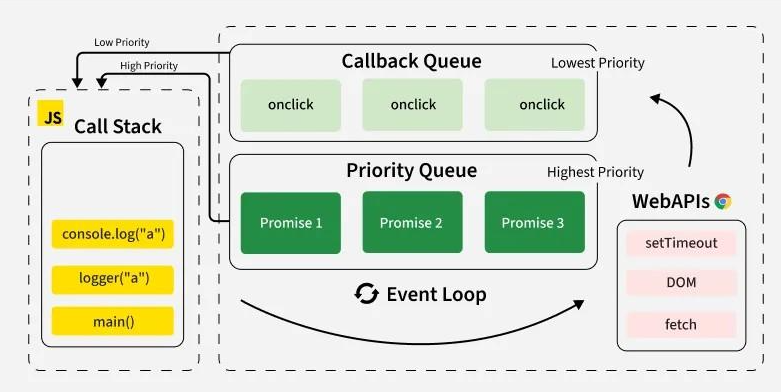
If you’ve ever wondered how JavaScript handles multiple tasks while being single-threaded, the answer lies in one of its most fascinating mechanisms — the Event Loop.
Here’s a quick deep dive 👇
What is the Event Loop?
The Event Loop is what allows JavaScript to perform non-blocking asynchronous operations — even though it can only execute one thing at a time.
It continuously checks the Call Stack and Task Queues, ensuring your async functions, API calls, and promises all get processed in the right order.
How It Works
- JavaScript executes code line by line on the call stack.
- When it meets async tasks (setTimeout, fetch, Promise, etc.), those are handled by the Web APIs (outside the main thread).
- Once completed, their callbacks go into queues.
- The Event Loop keeps checking:
- If the call stack is empty, it pulls callbacks from the microtask queue (like promises).
- Then, it moves on to the macrotask queue (like setTimeout, I/O, etc.).
Quick Example:
console.log("A");
setTimeout(() => console.log("B"), 0);
Promise.resolve().then(() => console.log("C"));
console.log("D");
Output:
A
D
C
B
Why? Because microtasks (Promises) always run before macrotasks (Timers) — that’s how the event loop prioritizes them. ⚡
In Node.js
The same concept applies, but Node’s event loop has phases — timers, poll, check, etc. Between each phase, microtasks are processed, keeping async behavior consistent.
TL;DR
Event Loop Orchestrates async tasks
Microtasks Promises, high priority
Macrotasks Timers, I/O, low priority
Call Stack Executes code line by line
Result Smooth, non-blocking JavaScript 🔥
The Event Loop is what makes JavaScript feel magically asynchronous, even though it’s powered by one thread. Mastering this concept unlocks a deeper understanding of async/await, performance optimization, and debugging complex code.
#JavaScript
#EventLoop